
NEWS PROVIDED BY
Institute for Faith and Culture
Oct. 30, 2026
FORT LAUDERDALE, Fla., Oct. 30, 2025 /Standard Newswire/ — The Institute for Faith and Culture releases the following National Survey on Socialism and Responsibility for the Poor:
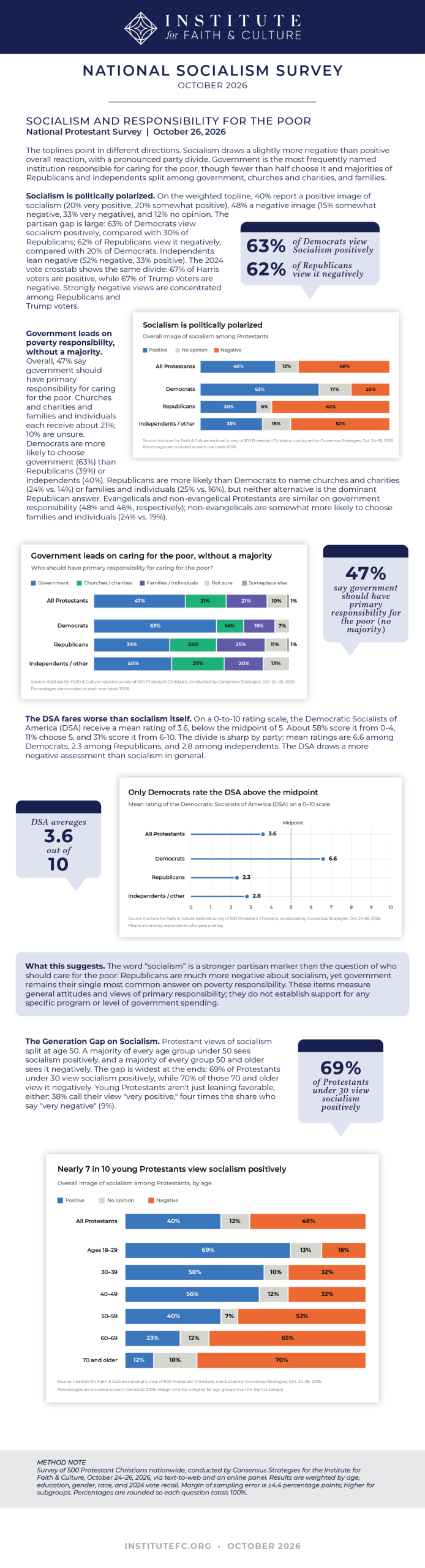
The toplines point in different directions. Socialism draws a slightly more negative than positive overall reaction, with a pronounced party divide. Government is the most frequently named institution responsible for caring for the poor, though fewer than half choose it and majorities of Republicans and independents split among government, churches and charities, and families.
Socialism is politically polarized. On the weighted topline, 40% report a positive image of socialism (20% very positive, 20% somewhat positive), 48% a negative image (15% somewhat negative, 33% very negative), and 12% no opinion. The partisan gap is large: 63% of Democrats view socialism positively, compared with 30% of Republicans; 62% of Republicans view it negatively, compared with 20% of Democrats. Independents lean negative (52% negative, 33% positive). The 2024 vote crosstab shows the same divide: 67% of Harris voters are positive, while 67% of Trump voters are negative. Strongly negative views are concentrated among Republicans and Trump voters.
Government leads on poverty responsibility, without a majority. Overall, 47% say government should have primary responsibility for caring for the poor. Churches and charities and families and individuals each receive about 21%; 10% are unsure. Democrats are more likely to choose government (63%) than Republicans (39%) or independents (40%). Republicans are more likely than Democrats to name churches and charities (24% vs. 14%) or families and individuals (25% vs. 16%), but neither alternative is the dominant Republican answer. Evangelicals and non-evangelical Protestants are similar on government responsibility (48% and 46%, respectively); non-evangelicals are somewhat more likely to choose families and individuals (24% vs. 19%).
The DSA fares worse than socialism itself. On a 0-to-10 rating scale, the Democratic Socialists of America (DSA) receive a mean rating of 3.6, below the midpoint of 5. About 58% score it from 0-4, 11% choose 5, and 31% score it from 6-10. The divide is sharp by party: mean ratings are 6.6 among Democrats, 2.3 among Republicans, and 2.8 among independents. The DSA draws a more negative assessment than socialism in general.
What this suggests. The word “socialism” is a stronger partisan marker than the question of who should care for the poor: Republicans are much more negative about socialism, yet government remains their single most common answer on poverty responsibility. These items measure general attitudes and views of primary responsibility; they do not establish support for any specific program or level of government spending.
Method note. Survey of 500 Protestant Christians nationwide, conducted by Consensus Strategies for the Institute for Faith & Culture, October 24–26, 2026, via text-to-web and an online panel. Results are weighted by age, education, gender, race, and 2024 vote recall. Margin of sampling error is ±4.4 percentage points; higher for subgroups. Percentages are rounded so each question totals 100%.
SOURCE Institute for Faith & Culture
CONTACT: Lauren Cooley, 954-829-3194, lcooley@crpc.org